
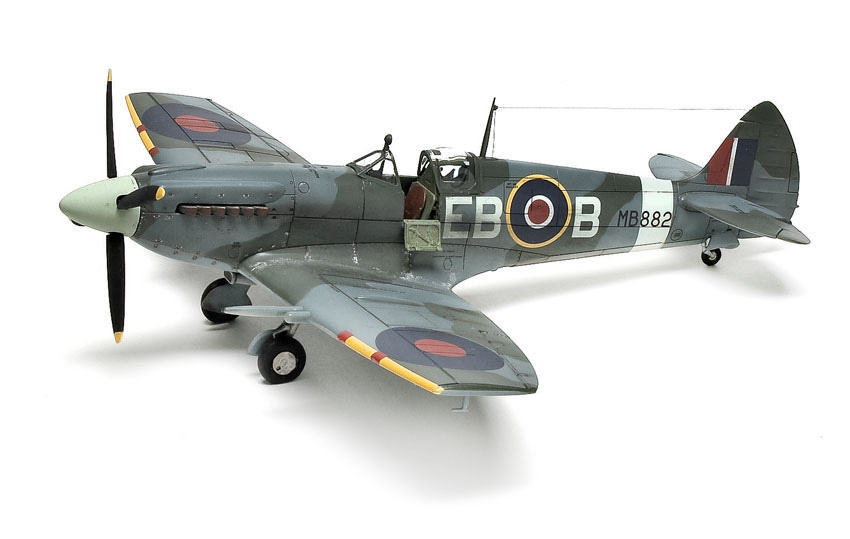
The Spitfire Mk.XII marked the first installation of the powerful Rolls-Royce Griffon engine in Supermarine’s graceful fighter. Essentially an interim variant, it mated the Griffon with the Mk.VIII/XI airframe. A hundred were built, equipping two squadrons whose primary role was to intercept Luftwaffe hit-and-run raids.
The Mk.XII marks an important transition in Spitfire history, one that until now had only been available to modelers through conversion sets.
This terrific kit clearly demonstrates the capabilities of a revamped Airfix. Easy construction, balanced with smart engineering and a good level of detail, will satisfy most modelers and give superdetailers a good start. Engraved surface features are a little heavier than on Tamiya or Hasegawa kits, but the lines are sharp and look good under paint. The kit includes a seated pilot with separate arms, but the molding is a little clunky. I left him out of my model.
I found the options particularly impressive: open or closed canopy and cockpit door; raised or lowered flaps; up or down landing gear; posable control surfaces; and a slipper fuel tank. Alternative parts are provided for all of these options, so there’s no need to adapt a part that’s optimized for one position to a different option.
The canopy is especially well done, with three parts for the closed option and a single part for the open option to represent the canopy slid back over the turtle-deck glass. Minor surgery is required if you choose this option (as I did), but the instructions are clear and the lines are scribed inside the fuselage. A separate hatch is included, so you don’t have to preserve the part removed from the port fuselage.
The cockpit is correctly represented as floorless, and is built up as two sections — the instrument panel with control stick and pedals, and the seat with two frames and some equipment for the area behind the pilot. There is an awkward ejector-pin mark in the bottom of the seat that is difficult to remove.
These assemblies snap into place in the fuselage halves — I used the tip of a knife to be sure they were seated just right — and the body closed up perfectly around them with no filler required. (A pesky seam reappeared on the top of the cowling during construction, but that was probably my fault, not the kit.)
The rest of the major parts were virtually trouble-free. The only area that required extra work was where the rear of the wing flared into the body. I carefully sanded to mating surfaces on both parts to get a clean fit and used a little super glue to fill minor gaps. I also trimmed the locating tabs for the wingtips for a better fit.
I added the control surfaces, putting just a little offset in the rudder and elevator. There are two shallow ejector-pin marks on the underside of the ailerons. I installed the flaps stowed because, unless they were being serviced, they were up when the aircraft was on the ground to prevent the engine from overheating (the flaps blocked airflow through the underwing radiator). I thinned the edges of the radiator scoop slightly for a better scale appearance.
After painting with Model Master enamels (see Page 22 in the instructions) and a coat of Pledge Future floor polish, I applied the markings. Airfix has really improved its decals, and these laid down perfectly over the gloss and responded well to Micro Sol. I ran a sharp No. 11 blade along panel lines to ensure a perfect fit for the decals, then added the last pieces.
The finished model scales out nearly perfectly and matches photos of Mk.XII Spitfires very well. The options, engineering, and ease of construction make this kit a winner, and I recommend it to anyone.


