
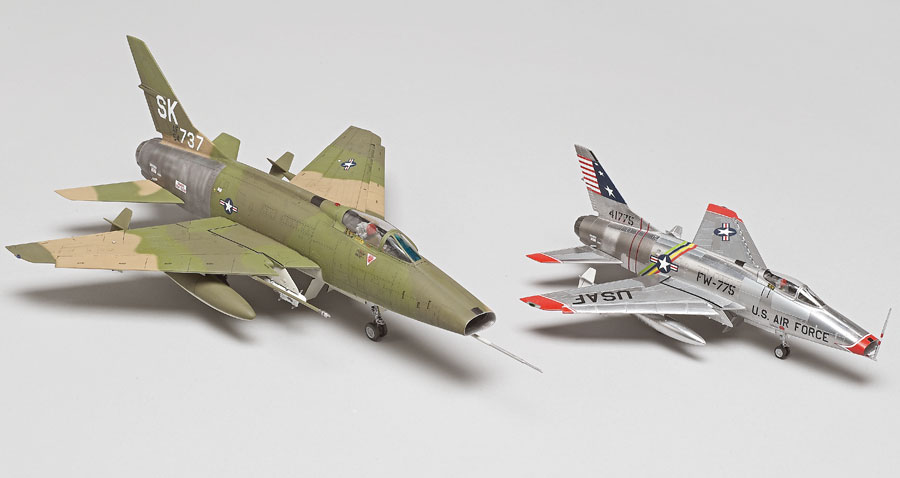
In either 1/72 or 1/48 scale, Trumpeter’s F-100C kits have well-detailed interiors with separate rudder pedals, stick, instrument panel, and two-part seat. The seat looks like that of the later D and F models.
Jon painted and dry-brushed raised detail on the 1/48 scale instrument panel and consoles, rather than use the gaudy, oversized decals provided. However, there is no such molded detail in 1/72 scale; Paul used the decals. The 1/72 scale instrument panel decal was much too large, but an errata sheet provided a smaller one. Neither kit has a clear gunsight panel. Both kits have two-piece canopies and handy boarding ladders, but no mechanism to hold the canopy open.
The long intake trunk fit in the nose but is too flat on the bottom, giving the opening an uncharacteristic “frown.”
Trumpeter has toned down surface detail on the 1/48 scale kit, with mere hints of recessed rivets. In 1/72 scale, only a few small access panels have recessed rivets.
Each kit has loads of options, including extended and folded pitot booms. Trum-peter also includes two styles of exhaust nozzles, one standard and the other from surplus F-102s. The latter is appropriate for late-service Air National Guard Huns. You also get two types of speed brakes and housings, and straight and “cranked” refueling probes, but there is no instruction on which is appropriate for a particular jet. A barrier hook is also provided, appropriate for late-service C models. The 1/48 scale kit has separate clear parts for the flip-down landing lights under the fuselage. These are simply engraved in the 1/72 scale kit.
Underwing things include two early 275-gallon drop tanks plus inboard pylons with Y-shaped mounts for pairs of Side-winders. Beautiful nine-part, triple-ejector racks for the inboard pylons are included, but they weren’t usually mounted, even during the Vietnam War. Also included in the kits, but not mentioned in the instructions, are a centerline pylon with optional practice-bomb dispenser or an ALQ-31 electronic-warfare pod. However, these ordnance options were not typically used, either. Missing are the trapezoid-shaped inboard braces found on each pylon of the C models.
Landing-gear detail is terrific, with four doors and four actuator rods for each main bogey. The main-gear wheel housing even has a couple of added detail parts. However, the main-gear tires are too thin and too tall.
Overall fit is good in both kits, but watch out for the sprue gates on each fuselage half; they leave bumps along the mating surfaces, requiring extra cleanup. The upper and lower surfaces of the wings produce an uneven join to the fuselage, so filing, filling, and sanding are needed. Each kit has separate leading-edge slats in the extended position, typical of Huns at rest.
Paul notes that photos show the fins of both kits are too large, and that the fluted trailing edges of the rudders should have eight sections instead of 10 as in both kits.
Beautifully printed decals offer markings for a natural-metal Iowa Air Guard Hun and a New Mexico Air Guard bird in Southeast Asia war paint. Jon finished his camouflaged 1/48 scale jet with Model Master enamels along with Alclad II metallics and tints on the rear fuselage.
Paul’s 1/72 scale Hun is finished with SnJ Spray Metal, with Testors Metalizer colors on selected panels. One of the marking choices on the 1/72 scale kit was the candy-striped commander’s bird of the 479th Fighter Bomber Wing, but stripes were missing for the wing-tank noses, speed brake, front gear door, and pitot boom. So Paul updated the other marking choice of the 450th FBW by adding the large U.S. Air Force to the nose and moving the insignia to the rear. Although shown on the box top, the USAF for the wings was not included. Paul used spares for these as well as the narrow red turbine warning stripes around the rear fuselage.
Jon spent 20 easygoing hours on his model; Paul took 19 for his. Both are certainly attractive (the planes, that is) and relatively easy builds. Fans of early Century Series jets will be streaming to the aftermarket for corrective details as well as additional enhancements – not to mention the reams of colorful decal sheets sure to come.


