
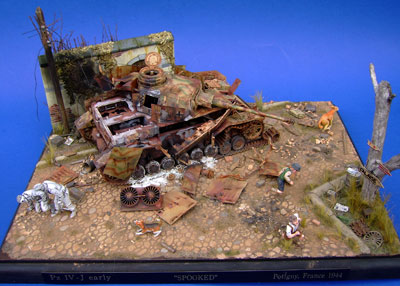
In our January 2007 issue, Karl Logan showed FSM readers how he modeled a destroyed Panzer IV, using a Tamiya kit with Verlinden and Eduard details. But that wasn’t all of the story – he put the tank into context with a twist. Subscribers can read on for details of the figures and diorama Karl built around his tank.
Subscribers can also check out more photos from Karl’s Panzer IV diorama.
After finishing the destruction of my Panzer IV, I set about building a diorama to go around it. In “Spooked,” a couple of curious French schoolboys exploring the wreckage are shocked to discover the ghosts of the tank crew lingering at the scene of their last stand.

Modeling the ethereal
The skeletal ghosts started their afterlife as two figures from Dragon’s 1/35 scale Survivors, Panzer Crew (Kursk 1943), set No. 6129. I turned them into ghosts with careful carving. First, I drilled out their eyes, shaping the empty sockets with a hobby knife. Then, I amputated their noses before drilling and shaping the nasal cavity.
After hollowing out the cheeks, I shaved off the figures’ lips and scribed toothy grins. (My trusty Optivisor proved invaluable here!) Moving to the arms, I performed the final surgery, using a sharp blade to turn the hands into bony claws.
For a ghostly pallor, I simply airbrushed the figures with Tamiya white, then picked out seams and details with a targeted wash of black artist’s oils.


Scared to death
The terrific boy and dog figures are two separate sets from Doug’s Originals (Nos. 35001 and 35A05). I modified the boy in the foreground, drilling out his mouth and using Squadron white putty to give him an appropriate screaming expression. I attached a “souvenir” helmet to the second boy’s head and detailed it with a lead-foil strap. The fleeing dog had his tail cut off, reversed, and tucked between his legs (appropriate for a scared mutt).
I use Winsor & Newton acrylics to paint flesh on my figures. The relatively rapid drying time versus artist’s oils makes it a little harder to blend subtle tones, but practice makes perfect (I’m still working on it).
First, I put on a base coat of raw sienna mixed with white. Then, I add highlights with a mixture of yellow ochre and white. A smidge of red can be added for rosy cheeks.
If the figure has a particularly well-sculpted face, I’ll give it a light wash of raw sienna oil paint lightened with a little white to pick out the creases. If the sculpting is not as refined, I use a fine brush to create creases and other facial features.
Next, I add the eyes. First, I add a white oval, then an iris and a pupil. After that, I clean up the face, retouching colors and adding shadows where appropriate. To paint lips, I use different colors depending on the stress or mood of the figure. Relaxed lips have a redder cast; stressed lips are pale. (Try it in the mirror – it’s true!)
Facial philosophy
As you can see, there are many variables in my methods. Every time I sit down to paint a face, my first thought is along the lines of “Oh man, I’ve lost it! I’ll never get this guy to look real!” But after several layers, a respectable amount of fiddling, and critical reappraisals over several days, I somehow seem to pull it off in the end. The lesson: Never get discouraged, and constantly strive to improve your method and skill. The best advice I ever received was from a guy who had the temerity to tell me I needed to improve my figures. He was right. I’ve seen lots of good models diminished by a lackluster, poorly finished figure. I believe a well-executed figure is paramount in drawing observers into a model. So, take a deep breath, stop procrastinating, and practice painting faces.
I painted the kids’ clothes and other personal items with acrylic colors, picking out details with a #00 brush and brown and black oils.


Signs of life
I found the wall in my spares box; it is one of Italeri’s vintage diorama moldings. It’s molded hollow, so I built the up the reverse side with styrene card using the wall itself as a pattern. After scribing a simplified stone pattern in the card, I painted details of the stones and the rest of the wall with craft acrylics. The red brickwork got a wash of tan artist’s oils to depict mortar.
I attached cilantro leaves with white glue to plant a climbing vine. Pieces of a slender root depict defoliation near the tank. The wall was then weathered with shades of green and yellow, or black smoke where appropriate.
I used branches from a decorative thatch to create the denuded trees. Synthetic grass inserted into predrilled holes completed the garden.
The telephone pole is a Verlinden product. I wired it with black thread stiffened with super glue. Finally, I painted accessories and wartime debris and scatttered them over the base.
Large components such as the tank are attached to the base with thick craft glue, but I used super glue for the figures.
REFERENCES
Panzerwrecks 1 & 2, Lee Archer and William Auerbach, by William Auerbach, available at http://www.panzerwrecks.com/
Last of the Panzers: German Tanks 1944-45, William Auerbach, Arms & Armour Press, Dorset, England
Panzer IV – Compendium Modelling Manuals #21, Compendium Publishing, London, England
Modelling the Panzer IV in 1/72 scale, Alex Clark, Osprey Publishing, Oxford, England
PzKpfw IV in Action, Bruce Culver, Squadron/Signal Publications, Carrollton, Texas
Panzerkampfwagen IV Ausf G, H, and J, 1942-45, Hilary Doyle and Tom Jentz, Osprey Publishing, Oxford, England
Panzer IV – The Panzerkampfwagen IV Medium Tank 1939-1945, Kevin Hjermstad, Squadron/Signal Publications, Carrollton, Texas
Inside & Out – A Modeller’s Guide to Improve Scale Model Kits No. 2, Milan Kosek, Wings & Wheels Publications, Prague, Czech Republic
Panzer IV, Horst Riebenstahl and Horst Schiebert, Schiffer Publishing, Atglen, Pa.
Panzer IV and Its Variants, Walter J. Spielberger, Schiffer Publishing, Atglen, Pa.
Sd.Kfz. 161 Pz.Kpfw. IV Ausf G/H/J Vol. 2, Waldemar Trojka, J.J. Fedorowicz Publishing, Manitoba, Canada
Panzers in the Gunsights, Steven J. Zaloga, Concord Publications, Hong Kong

