
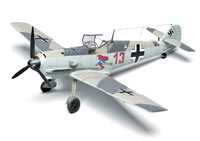
Kit: No. 3001
Scale: 1/32
Manufacturer: Eduard, 420-47-611-8259, www.eduard.cz Price: $74.95
Comments: Injection-molded, 217 parts (51 photoetched metal), decals
Pros: Detailed engine; prepainted photoetched metal; self-adhesive canopy masks
Cons: Cowling fit problems; exaggerated surface detail on control surfaces
Issue Published: September 2009

One of the iconic aircraft of World War II, the Bf 109E was present at the start of the war and in its final days. The E version became famous as Germany’s Battle of Britain fighter, nemesis of the Spitfire and Hurricane.
Eduard’s all-new, state-of-the-art Bf 109E is cleanly molded in light-olive plastic and complemented by photoetched-metal parts, canopy masks, and a complete engine compartment.
Construction starts with the interior. The cockpit and oil-cooler assembly are multipiece affairs enhanced by photoetched-metal parts. Be aware that the photoetched-metal grilles, parts PE32 and PE33, are too large; Eduard has tucked properly sized replacements into cardboard inserts packed with the photoetched-metal frets.
The DB601 engine and cowling machine guns are nicely detailed. You will need to decide whether to build the model with the engine installed and the cowling off or the cowling all buttoned up. In the latter case, the engine is not installed; alternate parts are provided for the exhaust.
Building a “closed-up” 109, I test-fitted parts and ran into a few issues. Part G9 must be modified to allow the machine-gun compartment cover A9 to fit properly. Checking the fit of the cowling Part A6, I found it was too narrow (perhaps a random molding flaw). To resolve the problem, I widened it with a sprue runner. The cowling side panels (parts E9/14) are a nuisance, as they are slightly undersized. The assembled cowling was a tight fit.
The wings went together easily. All the control surfaces are separate parts. I thought the surface detail on the wing flaps and ailerons was a bit too prominent. Also, my eye kept returning to the wing slats. They looked deeper than in photos and drawings.
The fuselage is a complex jigsaw with a few fit issues. The wing-to-fuselage fit is snug, but overall a positive fit. The rudder and tail-plane control surfaces are separate parts and, with a little modification, can be positioned as desired.
Parts for the windscreen and canopy are very clear, well molded, and fit perfectly.
I painted my 109 with Tamyia acrylic Luftwaffe paints. Cartograf decals for four different aircraft are beautifully printed and easily applied. A full set of stencil decals is also provided.
My primary reference was Kagero’s Bf 109E, Volume 1, by Jakub Plewka. The completed model dimensions and profile are good, but the stance looks a bit nose-high.
I completed my Messerschmitt in 20 hours and it looks good. While not for beginners, Eduard’s Bf 109E-1 will be an enjoyable project.
Read more model kit reviews.


