
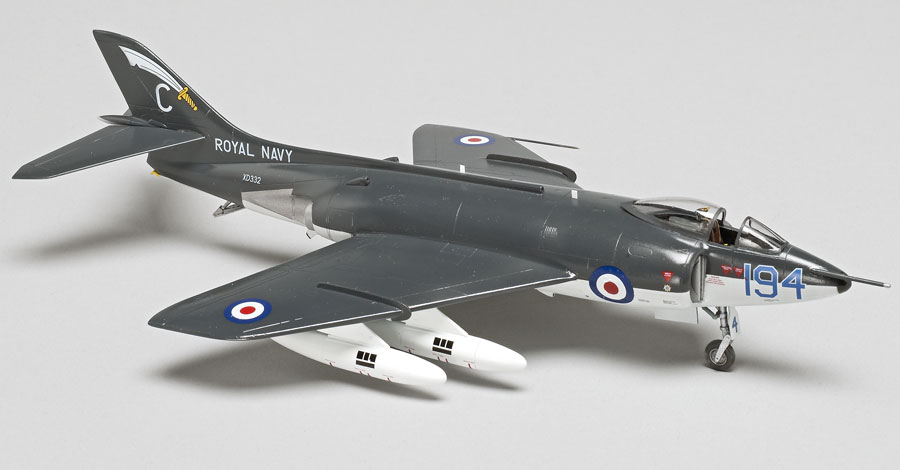
Supermarine Aviation’s long and distinguished history of building fighter aircraft came to a close in the 1950s with the Scimitar, last in a lineage most famous for the Spitfire. Overshadowed by the Sea Vixen as an interceptor, and passed by the Buccaneer as a low-level attacker, the Scimitar eventually served as an inflight refueling aircraft for those two planes. However, the Scimitar’s innovative design did introduce swept-wing aircraft to the Royal Navy.
Xtrakit’s injection-molded model includes recessed panel lines, a resin ejection seat, and decals for two options. But, as with many limited-run kits, it will require extra effort and patience.
The eight-page instructions are presented in the exploded-view format common to Eastern European manufacturers. Of course, construction begins with the cockpit. This kit, however, has nine subassemblies to be sandwiched into the fuselage halves before gluing them together. Most of these will require sanding to get a good fit. I cut Part 3 in half vertically to facilitate its fit into the intake trunks and reduce the work needed to get it into the fuselage. Don’t forget to add nose weight; I stuffed about 14 grams around the cockpit.
Stubs on either side of the fuselage locate the wings. However, you’ll need to scrape the inner edges of the wings to get them to fit. The wings have a slight anhedral, so test-fitting is a must. I used the drawing on the instructions as a guide and employed the “Mk.1 Eyeball” for alignment. This area was the only place on the model needing filler.
I suggest attaching the stabilizers and pitot tube at the end of the build. I didn’t and knocked them off a couple of times, eventually having to replace the pitot with a pin.
There are several small intakes located around the fuselage. None had openings in them, so I gouged them out with a hobby knife, then a drill.
I painted the model with Gunze and Tamiya acrylics, but deviated a little from the painting guide. My references for aircraft 194 showed the demarcation line between the white and gray was lower on the intakes than on the fuselage, different from the instructions. The decals are very thin and not easily moved once in place. Also, the roundels are somewhat translucent, although it only showed up on the intakes. I used spare decals to double up and hide the shades of white.
I really like how my Scimitar turned out, though the 30 hours I spent was more than anticipated. Given the number of small parts and fit issues, I’d recommend this kit to more-experienced modelers. However, it does make a great addition to any Royal Navy collection.


