
Tamiya’s 3-ton 4 x 2 cargo truck is hard to recognize in this state. Before beating it to pieces, Dan added new cargo-bed screens, photoetched-metal storage bins, more photoetched metal from Eduard for tools, clamps, and chains, a fully plumbed, scratchbuilt engine — then did his best to destroy all of the above. His destructive efforts included smashing the windshield, then tearing up the upholestry and inserting springs.

“I think I found your problem right here.” Dan modeled the demise of this German vehicle by blowing out walls and painting and weathering black and burned metal, shades of rust, and streaks, dents, chips, scratches, and ashes.

Dan achieved the look of worn, chipped paint by painting a metallic base coat, applying Maskol liquid mask, overpainting the masking, then removing it to reveal the metal underneath. Other scratches and chips are selectively applied metallic paints.

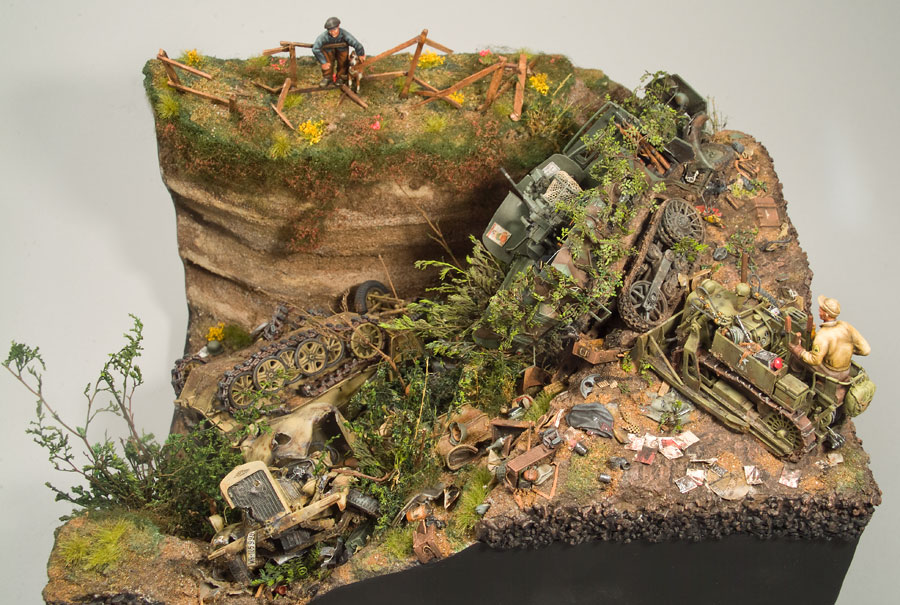
The strata in the earth walls of the ravine is based on Dan’s knowledge of Normandy’s geology. He built up the topography with plastic foam, Celluclay, and balsa wood, and sculpted the road and tracks in clay. Granular sand and silt texture the earth work, while static grasses and flowers and plants provide ground cover. He painted with artist’s oils and acrylics, and weathered with natural green and earth tones of powdered pigments. Across the ravine, a sculpted dog keeps company with a converted DES figure. Aaron Skinner photo.
To see more of Military Miniature Society of Illinois’ annual show, where we photographed Dan’s diorama, get your copy of Great Scale Modeling 2011; it’s available here. And you can see more of Dan’s work in the November 2008 FineScale Modeler magazine; back issues of FSM are available here.
Both publications are also available by calling Kalmbach customer service at 800-533-6644 (262-796-8776 international).

And a Joe to drive the ‘dozer: Dan converted a Verlinden resin figure by repositioning its arms, legs, and hands.

Dan added Eduard photoetched metal for tools, clamps, window blocks, instrument panels, small-arms racks, and toolboxes on Dragon’s SdKfz 250/11, then blew it to smithereens. Fenders, tracks, wheels, and side armor were badly abused, and heavy weathering was applied throughout.

Dan loaded up Calibre 35’s U.S. Clark CA-1 bulldozer by scratchbuilding a searchlight and lenses, detailing the radiator cover with improved clamps and a filler cap with screws, washers, and wingnuts. The driver’s seat is enhanced with foil and brass sheet.

Somewhere down there is a French 75mm M97/31 field gun. On the edge at the top is a Selbstfahrlafette 2cm FlaK 38 truck in a German/French camouflage.

No sneaking out this back door; Dan modeled more battle damage here. Interior details were reconfigured for an inverted pose.

It was slow going after D-Day as the Allied forces fought their way inland from the Normandy landings on June 6, 1944. But as the tide began to turn that summer, the Germans were in danger of being surrounded. Indeed, much of the Wehrmacht was cut off from retreat in fierce fighting that ended the battle for Normandy in the Allies’ favor in mid-August.
The aftermath of the battle was a massively horrific cleanup operation — which is where the story of Dan Tisoncik’s multi-dimensional diorama begins.
Dan writes: “The destruction of the German forces in the Falaise Pocket in August 1944 is one of the most famous episodes of the Normandy campaign. This diorama represents the post-action cleanup of the killing ground, which was littered with destroyed German equipment throughout. Here, the U.S. Army Corps of Engineers helps sweep the scrap metal of the 116th Panzer Division and the 227th Infantry into a ravine as a local boy looks on from across the way.”
Dan, who has won more modeling awards and trophies than he cares to keep, eschews competitive modeling in favor of conducting seminars and taking on new modeling challenges.
This diorama demonstrates his ideas of “breaking the horizontal plane” to add interest to a display base, taking groundwork to new heights to model a deep ravine in what he calls a “split vertical space.”
Dan shares he philosophies on diorama composition in lectures accompanied by a PowerPoint presentation. He summarizes his main talking points:
A composition can be simple or complex, large or small
The composition formula I use: vehicle + setting + figure = story (theme)
Compositional elements include:
- Space: horizontal (minimum and compact); vertical (plane 0 to 90 degrees); and internal space (interiors)
- Geometry: Figures and vehicles focus viewers’ attention into triangular space framed by vehicles and/or figures
- Theme: The story line that binds all other elements together in a mood that can be passive or active
A scientific approach comes naturally to Dan: As an environmental engineer, he is a scientist who applies his eclectic background to all aspects of modeling. For example, in planning his groundwork, he says, “As a geologist, I am always interested in the terrain battles were fought on. I always do heavy research in photos and reading, and as this was a long project it was a lot of reading. In Falaise, the typical terrain had these deep gullies full of alluvial deposits. Many of the pictures I saw had gullies like what I tried to depict here.”
Having staked out the groundwork, Dan’s challenge was to fill it sufficiently full of wreckage to convey the end of the story in Normandy. By the time he finished, his diorama was so complex it couldn’t be completely taken in from one angle. We showed a couple of perspectives in the March 2011 FSM. Now, with the help of additional detail photos taken by Dan, we’ll delve deeper into a scene that seems to reveal something new with each viewing.
