
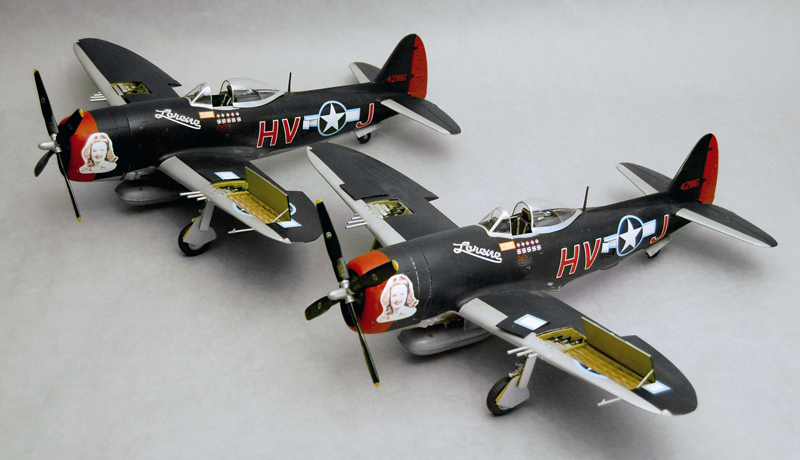
In the November 2013 issue, FineScale Modeler presented a special Showcase featuring a pair of 1/24 scale P-47s built by Dave Gianakos, a frequent contributor to FSM. The models were identical twins: One went to the aircraft’s pilot, Russell Kyler. The other went to Boxted Airfield Historical Group & Museum, in the village of Langham, near Colchester, Essex, England.
During World War II, Royal Air Force Station Boxted was home to the famous 56th Fighter Group, also known as “Zemke’s Wolf Pack” for its commander, Hubert “Hub” Zemke. Among its pilots were America’s leading ace in Europe, Francis “Gabby” Gabreski and a bright, young pilot from Pennsylvania — U.S. Army Air Force 2nd Lt. R. Kyler.
Still sounding sharp and lively at 89, Russell apologized for a slight delay in scheduling. He had been busy moving to Texas, and had some computer troubles as well. Still, he graciously granted us an interview.
Born and raised in Huntingdon, Penn., Russell was just a youngster — “8 or 9,” he recalls — the first time aviation intrigued him. He says:
“An airplane flew over, and I kept looking at it and thinking, ‘there’s something wrong with that plane.’ Then I realized it didn’t have any landing gear — there weren’t any wheels on it.
“We had a little airport in town, but everything there had wheels, fixed gear. At the time I didn’t know there was such a thing as retractable landing gear. So I got all excited about this guy taking off without anything to land on. What was he going to do?
“Later, I realized it was a Beech D17 Staggerwing. That got my interest started in aviation.
“I always said I wanted to be one of two things: an electrical engineer or a military pilot. And military pilot won out because of the war coming along when it did.”
Russell was a high school senior when the war started. After graduation, he took a summer course in aircraft rewiring at a military vocational-technical school in Harrisburg, Penn. When he turned 18, his parents granted him permission to enlist.
“I knew I wanted to be around aircraft,” he says. “At that time, they were giving voluntary enlistments a little priority in their assignments over people who were being drafted. So I enlisted with the idea that I would be assigned to an aviation unit.”
After basic training at Keesler Air Force Base in Biloxi, Miss., and aircraft weaponry courses at Lowry Air Force Base in Denver, he volunteered for air gunnery school and was sent to Apalachicola Army Airfield in Florida. Graduating in February 1943, he was bumped from private to staff sergeant in one promotion and assigned to an attack and bomber squadron at Will Rogers Field in Oklahoma City. When his application for pilot training was accepted, he was sent to an aviation cadet center in San Antonio. He says:
“We got our preflight training, all our ground school training there, and that determined whether we were qualified to be pilots or not. So, I was accepted on that and assigned to Coleman [Flying School] in Texas.”
He flew primary trainers at Coleman, basic trainers at Majors Field in Greenville, Texas, and, finally, the AT-6 Texan at Eagle Pass Army Airfield in Texas, earning his wings on Feb. 8, 1944. He says:
“I was promoted to second lieutenant and given two weeks leave. I went home, got married, and went back to Eagle Pass for advanced training in the P-40 (Warhawk).”
Three months later he was in Baton Rouge, La., with a P-47 Thunderbolt training squadron. From there he shipped out for England.
“I was at a little airfield in northern England for a couple of weeks and got some transition training flying in the unique weather conditions they have in that part of the world. From there I was assigned to the 56th Fighter Group. I signed into the 56th on Aug. 24, 1944.”

Photos courtesy of: Russell Kyler; Peter Randall of www.littlefriends.co.uk; Dave Gianakos; and the U.S. Air Force.

Russell would fly 47 more missions and eventually become a flight leader himself, doing his part to help make the 56th the winningest fighter group in the Eighth Air Force.
The 61st Squadron flew Thunderbolts in a distinctive yet oft-debated color scheme. For all the opinions on the colors of the plane, Russell and other members of the 61st maintain their P-47s were flat black on the top and sides, with natural metal on the underside and leading edges. Russell says:
“I don’t really know, but looking back I think the squadron commander was given a prerogative on what colors to paint the aircraft. So, where the black came from, I don’t have any idea other than when the plane was on the ground it blended in real well as far as a good camouflage. And, of course, when you’re flying and you get up fairly high, the natural metal blended right in with the sky colors. And the thin cloud layers you usually had at altitude made it difficult to see as well.
“Besides that, it made it a good-looking airplane. It was a good-looking machine. And to the pilots that flew the Thunderbolt, it was the only plane to fly in combat.
“We used to joke that if you wanted to impress the women you told them you were a P-51 pilot. If you wanted to impress the other pilots in the war zone, you told them you flew the Thunderbolt. They knew just exactly what you were referring to. It was a flying tank. It was nearly impossible to shoot down.”
The Germans did their best, though. Strafing an airfield in Germany, Russell’s plane was punched in the nose by a couple of 20mm cannon shells.
“I took two direct hits in the engine, and it destroyed one cylinder on the front bank and another on the back nine. From the time I got hit to the time I got back to England was more than an hour.
“I knew I’d been hit, I heard the 20s hit me, but the only indication of anything wrong was my oil pressure kept dropping and dropping and dropping. It finally pegged out at 0. But the plane was still flying good, so I thought, oh well, maybe the gauge is gone.
“I managed to get back to England and land all right. I had quite a bit of oil on the windscreen and canopy, oil all over up there. I shut the engine down and the crew chief jumped up on the wing and said, ‘My God, you’ve got a lot of oil on the outside of this!’
“I said, ‘Yeah, I took a couple of hits about an hour ago. I don’t know how bad it is. The airplane’s been running real good, as far as that goes, but I just don’t have a lot of power.’
“I could pull normal rpms and manifold pressure — what we used back then for cruise settings was 2,000 rpm and 30 inches of manifold pressure, just our routine best settings to be comfortable flying the aircraft and get good fuel consumption — and it wasn’t running rough. It just blew all the oil out of the engine. The crew chief hollered at the crew chief on the next stand and brought him over and they unbuckled the cowling.
“I remember the crew said, ‘Well, my God!’ He was on the (port) side where I’d taken the hit. ‘You’ve got two cylinders shot off of that engine!’
“He said that engine shouldn’t even be running. He was overwhelmed by the fact that the engine hadn’t quit on me when it took the hit. They’d peppered me pretty good and I still flew for about an hour getting back home with it.
“They changed the engine out and patched those two holes [in the cowl] and I started flying it again. I put on what we called slow time on the new engine, we put about 10 hours of flight time on it, flying at different rpm and altitudes and breaking it in for combat. As soon as I put those 10 hours on it I went back to flying combat with it.”

Though the Thunderbolt was a formidable ground attacker, Russell mostly flew bomber escorts.
“The bombers would take off about two hours before we did — we were quite a bit faster. Once we got to the bombing area we’d usually put a squadron on each side of the bombers and another one out ahead of the bombers. We’d do S turns and various maneuvers to stay in position with them and to maintain a comfortable flying speed and watch for enemy fighters to come in on them.
“You just learned where to put your aircraft in relation to who you were flying with. You flew your position on the lead aircraft based on being able to read the letters on the side of the aircraft. You learned pretty quick exactly where your flight leader wanted you to be.
“Once we spotted [enemy fighters] we’d drive off all of them that we could. The big problem with our Thunderbolts was their lack of range, because that big engine used so much fuel. So we’d stay for our assigned time, and then we’d have to leave because we were so low on fuel we’d barely have enough to get home.
“After we broke off from the bombers, the policy was to look for targets of opportunity on the way home. So we’d drop down to about 10,000-12,000 feet and look for truck convoys or trains or something like that hauling military equipment, and we’d attack those and destroy as many of them as we could, strafe ’em and bust ’em up as best we could, and then just continue on home.
“I’d drop down to about 1,000 feet and set up my attack pattern. Then usually I’d get within about 450-500 yards of the target and that’s when I’d start shooting. Then I’d shoot down to about 100 yards. By then you were closing in pretty fast on the target and the ground, so you’d break off and regain your altitude and get set for another gunnery pass. But I’ve been down below treetop level on many a mission.
“We’d be traveling about 400, 450, 460 mph. That was pulling pretty much max power, but it gave you good stability and you weren’t an easy target at that speed.
“Normally, when we picked out a ground target, if they had antiaircraft fire support we’d locate the gun position and attack them, destroy them, and then we were free to attack the target however we wanted. So that was the first priority, to destroy any antiaircraft support they had. Then it was just like target practice back in the States. We didn’t have anything to worry about except maybe once in a while a gunner would slip back to his guns and try to get in a few rounds. Of course, we were always looking for that to happen, so as soon as they’d get a gun operational, as soon as they’d start firing, we’d knock ‘em out again.
“We’d continue until we either used up our ammunition or we got where we had enough fuel to get home but nothing more to play around with. Then we’d break off and head for home.
“We’d get back and we’d have parking spots for each aircraft. The crew chief would start his inspection and get the aircraft ready for the next mission.”
Russell was still at it when the war in Europe ended on May 8, 1945. It would be weeks before he left England. He was in the middle of the Atlantic on his return voyage when word came of the atomic bombs and Japan’s surrender.
“We landed and got on trains to Camp Kilmer (N.J.) and were reassigned from there. I wound up at Goodfellow Army Base in San Angelo, Texas, as an instructor pilot. We were flying primary trainers and I was teaching Chinese cadets how to fly. During that period of time I decided that being an instructor pilot teaching Chinese cadets who didn’t speak English how to fly wasn’t real conducive to longevity. When you had to use hand signals for everything, it got tricky from time to time.
“So, I decided I had enough time on active duty to get released from active duty and go on active reserve status. So, that’s what I did. I left San Angelo and went to Fort Indiantown Gap Military Reservation, Penn., near Harrisburg, to get processed to get out of active duty. I was relieved of active duty in April, 1946.”
So, Russell found himself back in Pennsylvania. But he wouldn’t remain. Working as a machinist at Tinker Air Force Base in Oklahoma, he flew occasionally with the Air National Guard. But then he became interested in helicopters, and the urge to fly returned — but the Air Force wouldn’t let him become a helicopter pilot.
“I sort of lost my cool,” he says. “I resigned my commission in the Air Force and enlisted in the Army and started a new career as an Army aviator and a helicopter pilot. I think it was 1964 — I would have been 38 — and I flew Hueys and Chinooks in Vietnam, then in Korea teaching them how to fly armed helicopters.”
With decades of experience as a pilot and instructor, Russell’s single best piece of advice?
“Know your airplane,” he says. “Gladych said, ‘If you know your airplane better than your enemy combatant, you can outfly him.’ So that’s something I intended to learn as soon as I was assigned to any aircraft, either fixed wing or helicopter. I got deeply involved in the maintenance of it. Any maintenance point you can learn, I strongly recommend that you learn it — all the different peculiarities that aircraft has at different power settings, things like that.
“Know your airplane.”

By then, fighter ace Gabreski and group leader Zemke were gone: It was a little more than a month after Gabreski had crashed and been taken prisoner in Germany, and Zemke had transferred out to begin flying P-51s with the 479th Fighter Group. When his P-51 shed a wing over Germany, Zemke also became a POW.
“People were saying, ‘The Hub’s down.’ I didn’t know who the Hub was or anything about it until I discovered that was the nickname they had given Col. Zemke because his first name was Hubert.”
However, he would soon become well acquainted with the colorful, well-traveled Bolesław Michal Gładych, better known to Americans as Mike Gladych.
“For some reason, Mike picked me out of the replacement pilots that went into the 61st Squadron. We had 18 pilots that went to the 56th Fighter Group, and they just split us up into three groups of six each and said OK, you guys go to 61st, you guys to the 62nd, you guys to the 63rd, and I was supposed to go the 61st. As we took our little tour and were given a briefing on how they operated and so forth, the CO looked at this guy standing back behind us — he was a strange-looking man, he wore American uniform pants and shirt, the old Army ODs, and a Polish blouse, and a Polish hat with British insignia on it, a unique-looking individual — and the CO said, ‘I’d like to introduce Maj. Gladych,’ and he told us about who he was. He said, ‘Mike, do you have anything to say to these new pilots?’
“Mike said no, but then he pointed at me and said, ‘I’d like to have that young man there to be my new wingman,’ since his previous wingman had been promoted and was in a different position.
“The CO said, ‘Alright, he’s yours,’ and just like that, I became his new wing man. We broke into little groups then, and Mike said, ‘Kyler, you come along with me. I want to talk with you for a little bit and tell you what I expect out of my wing man.’ So that’s what we did, and when we finished with that he took a piece of paper and said, ‘This X is my airplane, this X is your airplane, and you fly in this position. You maintain that position and I’ll always bring you home.’
“I thought that was quite a statement to make at that time. But Mike was true to his word. He looked after me like an old mother hen. I flew my first 10 missions as Mike’s wingman.”
