
REFERENCES
Sole Survivor by Dennis Hale as told to Tim Juhl and Pat & Jim Stayer, Lakeshore Charters & Marine Exploration, 1996, ISBN 978-0-9627084-2-8
Sikorsky HH-52A: An Illustrated History by Lennart Lundh, Schiffer, 2003, ISBN 978-0-7643-1782-8
Several years ago, I began building models of the various aircraft which had been assigned to U.S. Coast Guard Air Station Traverse City, including the HU-16E Albatross, HH-3F Penguin, HH-65A Dolphin, and others, including the HH-52A Seaguard. I began acquiring kits and researching various details of the Coast Guard versions of each of these aircraft. I decided to build my model of the Seaguard as the one that rescued Hale.
The biggest problem that I encountered was to obtain a model kit of that particular helicopter. I discovered that the Ringo Toy Corp., which was formerly the Ideal Toy Co. (Model Craft), had produced a kit in two separate releases in the 1960s. Marketed as the Sikorsky “Amphibious Helicopter” and as the “Battle Taxi of Vietnam,” it was approximately 1/50 scale (depending on which dimension you measure). I was able to locate one kit online at a price which I will not disclose in any manner which my wife might discover.
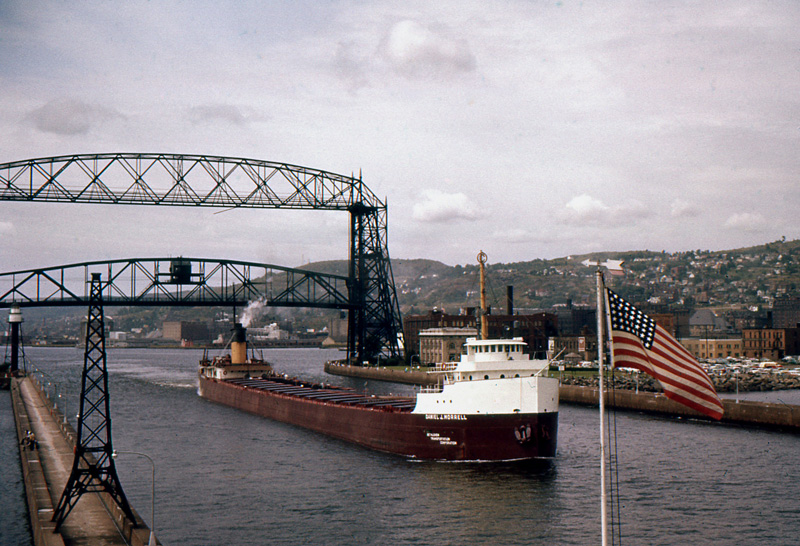
Fifty years ago, in the early morning hours of November 29, 1966, the 600′-long Great Lakes freighter Daniel J. Morrell broke in two and sank in Lake Huron, off the tip of Michigan’s “thumb.” It had left Buffalo a few days earlier and was upbound, empty, toward Taconite Harbor, Minn., for one more load of iron ore before winter shutdown. The previous trip would have been the Morrell’s last run. But it was pressed into service for one more voyage due to the breakdown of one of the other ships.
On Huron, the Morrell sailed into the face of a full-blown winter storm. The wind was out of the north-northeast at 65 mph, and the waves were upward of 25′, spaced 250-300′ apart. The severe pounding that the 60-year-old ship endured in the storm and the extreme stress of continuous flexing eventually caused the hull to fracture amidships. As it broke in two, power was cut to the bow section. So the radio room was unable to send an emergency distress signal. The aft portion, still under power, continued on, pushing the sinking forward section aside. There was a mad scramble in the forward deckhouse as crewmen clambered aboard the single metal life raft, which floated free as the bow section sank. One can only imagine what went on aboard the stern segment, which traveled about 5 more miles before it too went to the bottom.
About a dozen men were onboard the pontoon raft as it went into the lake. It immediately capsized, throwing all of them into the water. Four men were able to climb back aboard, but there was no sign of any of the others as the same treacherous seas that were able to destroy a large lake vessel now assaulted the tiny life raft. Clinging to whatever they could, the four men huddled together while they waited to be discovered and rescued. For three of them, it didn’t come soon enough. One by one they succumbed to hypothermia. Dennis Hale, dressed only in boxer shorts and what he could quickly grab — a pea coat and a lifejacket — somehow managed to survive.
Since no distress signal was broadcast when the Morrell went down, it was 34 hours before a search even began. At that time, U.S. Coast Guard helicopters and airplanes from Traverse City, Mich., and Detroit went out, as did several search vessels. After about four hours the crew of an HH-52A Seaguard helicopter, No. 1395, spotted the life raft in shallow water near the shore at Port Hope, Mich. They set down nearby and two of the Guardsmen waded over to helped Hale into the helicopter, which immediately flew him to the hospital at Harbor Beach. A local press photographer, Ralph Polovich, who was on assignment in an airplane for the Port Huron (Mich.) Times Herald, was able to capture the moment with his 35mm Nikon.