
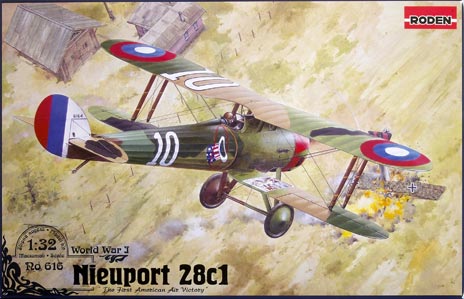
Kit: No. 403
Scale: 1/48
Manufacturer: Roden, available from Squadron Mail Order, 1115 Crowley Drive, Carrollton, TX 75011-5010, 979-242-8663, www.squadron.com
Price: $19.98
Comments: Injection-molded, 52 parts, decals
Pros: Good cockpit and engine detail, good fit
Cons: Decals silvered, lower wing droops
The Nieuport 28 was the last of that French manufacturer’s fighter designs to see action in World War I. It was flown primarily by Americans, notably the 94th and 95th Aero Squadrons before they were equipped with SPADs. Although fairly fast and agile, it had the disturbing tendency of shedding fabric from its upper wing in a high-speed dive.
Roden’s kit is crisply molded with excellent detail and sharp wing trailing edges. The control surfaces are not molded separately, but they are easy to score and bend into position without cutting them free. The windscreen must be cut and folded from a piece of acetate sheet included in the kit.
Decals are provided for five 94th Aero Squadron aircraft. A clever touch is the inclusion of stamp-like stickers representing the Liberty Bond posters that were pasted to the wings.
The cockpit is well detailed but difficult to see through the small fuselage opening. Separating the push-rod ring (part No. 8B) from its sprue was tricky; I used a fine-tooth razor saw. The biggest construction problem was getting the lower fire wall extension (21B) to fit to the fuselage and the two-piece cowling. The extension also serves as a mount for the forward landing gear strut. I carved away about 2mm from the forward ends of the bottom longerons of the interior to make the fire wall fit.
Because the French hand brushed their five-color camo scheme, I decided to do the same. All parts, except for cowl, struts and fin, were sprayed with Polly Scale French beige and then brushed with a couple of thin coats of the other colors.
Roden’s decals silvered badly despite the gloss coat. I had to hand brush the camouflage colors over the silvered areas. The fuselage decals are slightly oversize. On the other hand, the Liberty Bond stickers for the wings worked beautifully.
Mounting the wings and struts went smoothly, but I noticed the one-piece lower wing drooped at the tips. This was corrected by threading the 2-pound monofilament landing wires with just enough tension. I strengthened the landing gear with fine stainless-steel wires for the X bracing. The location of the tail skid is not well indicated.
The finished model is accurate in size and shape except that the rear fuselage is about 2mm too long. I spent about 38 hours on this model and recommend it to all WWI buffs who have biplane rigging experience.
– Dr. Bill Funcke