
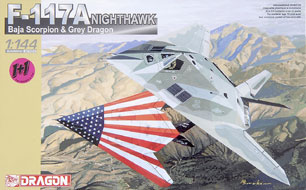
Manufacturer: Hasegawa, distributed by Marco Polo Import, 532 S. Coralridge Place, City of Industry, CA 91746, 626-333-2328
Kit: No. 00086
Scale: 1/72
Price: $20.98
Comments: Injection molded, 76 parts, decals
Pros:Excellent bomb crutches and GBU-27 bombs, canopy can be posed open, fine landing gear
Cons: Parts breakdown means extra filling and sanding, bomb crutches are fragile, canopy supports fragile

You knew as soon as Hasegawa released its new Stealth Fighter kit with no weapons bay but an opening for one that a subsequent release would include the bay and bombs. Well, here it is.
Most of the kit’s plastic parts are molded in black, but the new sprue for the bomb bay, crutches, doors, door actuators, and GBU-27 bombs is molded in white. Why? Because except for the bombs, these items are white in reality, and painting white over black is sometimes difficult. Hats off to Hasegawa for helping the modelers here. You still have to paint the landing gear struts, doors, and wheels white, though.
The one-piece canopy can be posed open; it rests on two thin retractor arms that attach to the ejection seat. Be careful – they’re fragile. The cockpit interior detail depends on decals for the panel and consoles, but the renditions of the instrument shroud and control stick are good. The ACES II seat has no harness detail and is missing its air sensors from the headrest. The kit includes a solid nose ballast to help balance the model (nice touch!).
I wasn’t pleased with the fuselage and wing assembly system. The upper and lower fuselage halves are not separated at the outer edges; the seam is inset from the leading edge of the fuselage by about 3/16″ on the bottom side. The wings are similar. So instead of cleaning up the glued edges, you’re left to filling and sanding seams on the bottom of the model. Also, since the wings are separate, you have to dress the wing/fuselage joints on the top and bottom, too. Depending on the filler you choose, you may be faced with painting the already-black plastic with black paint to cover the filler – an unwelcome extra step. The rest of the parts fit well.
I ended up ignoring the minor seams and chose not to paint the model black. Whoops, I had to break out the flat black paint to finish the canopy framing and paint the outsides of the bomb bay doors. The canopy is not tinted – the real ones have a dark yellow tint – so I mixed a little Tamiya Clear Yellow with Smoke (a dark clear tint) and sprayed the inside of the canopy. The rest of the model was coated with Future floor polish to prepare it for decaling.
The decals offer markings for a Desert Storm bird and a test machine from Edwards AFB. They went on fine without the need for decal solvent. The set of stripes for the bombs are way too short to go around the bombs as indicated. I put them on the bottoms of the bombs, the side most visible when the model is finished. I airbrushed Testor Dullcote over the nearly finished model, including the clear parts that depict the screens over the FLIR turrets.
Hasegawa’s rendition of the GBU-27 2,000 pound laser-guided bombs is excellent. So are the six-part bomb crutches. Note that the crutches are not the same; the right one has a rounded extension on the front end. While well detailed, the crutches are fragile and you must be careful installing them into the bay.
The end result is a fine model of the familiar “black jet.” The sizes, angles, and proportions look right. I put about 14 hours into the project. I recommend it to any modeler used to dealing with small parts, but be ready for some seam filling.