
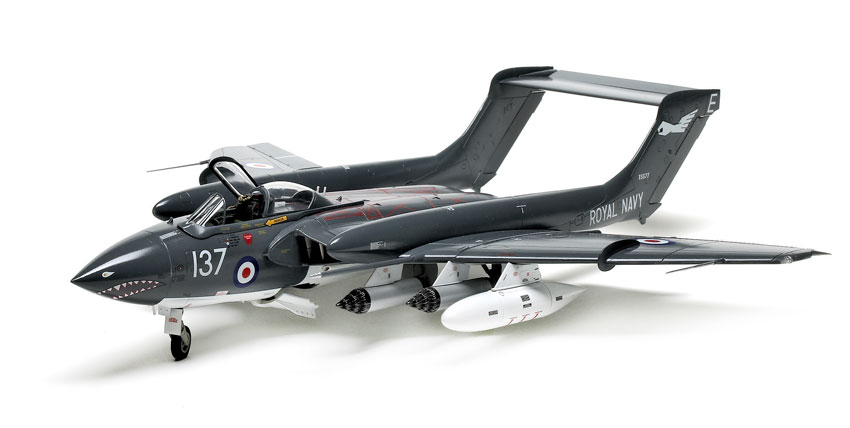
Some years ago, I saw some video of operations onboard a British aircraft carrier that showed Wessex helicopters, F-4 Phantoms, and de Havilland Sea Vixens taking off and landing. The thing that really struck me was how the Sea Vixen made the Phantom look almost dainty and nimble — two words that really should not appear in a sentence with an F-4! The Sea Vixen just looked so incredibly brutish and unorthodox in a carrier role — behemoth would not be too strong an adjective! It was the final and largest of de Havilland’s twin-boom jets, the others being the Venom and Vampire.
Now Airfix offers us the first injection-molded example of this aircraft in 1/48 kit scale. And they have done a very nice job of it, too! Initial inspection of the instructions and kit parts is promising: extended or folded wings; raised or lowered flaps and arrestor hook; open or closed canopies and air brake; and posable ailerons, tail plane, and rudders. The rudders and all-flying tail are designed to be movable once complete, but, unfortunately, the ailerons have to be fixed in one position. There also is a choice of weaponry, including unguided MATRA rocket pods or Red Top/Firestreak missiles. All four marking schemes are gloss dark sea gray over gloss white.
Construction of the model is fairly straightforward with few concerns. The cockpit is a nice representation of the “coal hole” in the real aircraft. Being painted black throughout, such a nickname seems most appropriate! (I’m really glad I’m not a Sea Vixen navigator. Vision out of the aircraft from this position is negligible, to say the least!)
I was tempted to build this model with the wings folded to save display space, but I built them extended. Although the wings’ fit in models with this feature is often suspect, I’m pleased to say these wings fit very well indeed. Hefty wing ribs certainly helped guarantee a solid construction. A downside of these ribs, though, are the sink marks on the exterior of the wings.
Actually mounting the wings is tricky, as there is no positive alignment method or placement guide. I did the best I could and put them where they looked right, and the fit turned out fine.
Don’t forget ballast for the nose! This aircraft is definitely a tail-dragger without suitable weight upfront. Fortunately, the nose cone is large enough to fit more than enough fishing sinkers or other weights to keep the nose wheel on the ground.
I painted the model with Tamiya TS-26 pure white and Testors gunship gray enamel, decanting the TS-26 from the spray can, then applying it with my airbrush. The overall clear gloss came from Tamiya, again decanted.
The decals are flat but thin and include several hundred (!) small stencils. They behaved very well and, once gloss-coated, blended well with the overall finish. I chose the aircraft from No. 899 NAS onboard HMS Eagle in 1975 because it had some rather distinctive touches — a shark’s mouth and nice flowers under of the tail!
Airfix has really filled a niche with this wonderful kit. Fleet Air Arm subjects have a strong following in the modeling community, and this is a welcome addition to the available kits. I enjoyed building it as assembles easily — while still requiring some good old-fashioned modeling skills — and looks great when complete. Nice effort, Airfix!


