
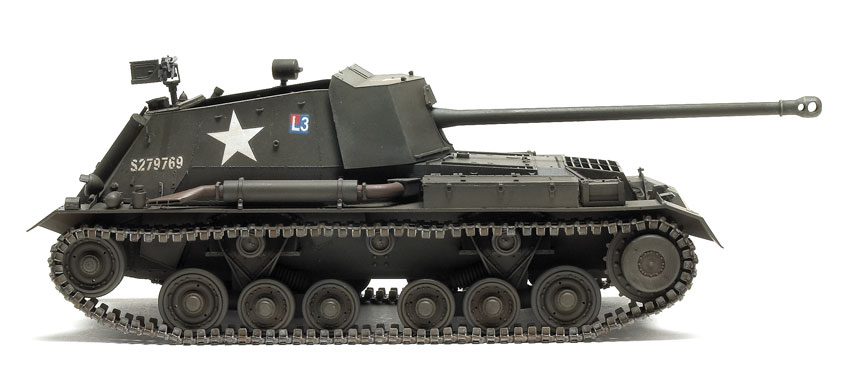
Bronco Models has released a highly detailed kit of the British Archer, a self-propelled 17-pounder antitank gun based on the Valentine chassis. The Archer was designed with an unusual rear-facing gun which gave the vehicle a lower profile and improved its stability. It served into the 1950s and many were sold to other countries.
Bronco’s kit comprises more than 1,000 parts, including a photoetched-metal sheet with enough parts to rival the inventory of some aftermarket companies. The tracks are individual links that click together. Bronco provides the rear drivetrain and radiators, but if you close their hatches you’ll never see them.
The 32-page color instruction book features good diagrams and four-view drawings with four sets of markings. I started assembly with the lower hull. While I skipped around building subassemblies, I built my Archer mostly following the instructions.
While the tracks click together, they then need to be glued; they are not strong enough to stand even light handling. Careful, though: Too much glue will melt the delicate connecting pins. The links took quite a bit of time to clean up and paint, and, though most of them fit well, a few wouldn’t hold together — and there are not many to spare. In fact, if you want to build one of the two vehicles that have three sets of spare tracks on the front plate, you will need to buy an additional set of tracks.
The interior of the vehicle is complete and requires experience with photoetched metal. Most of it was not a problem for me, but I did not have tweezers good enough to handle the tiny photoetched-metal tie-downs; I simply left the molded ones in place.
Another detail I found impossible was the wiring for the lights. Bronco suggests that you use stretched sprue and drill holes in the tiny connector blocks and lights.
I was impressed with the fit of the fighting compartment walls. Everything slotted in nicely. The only trouble I had was where the front plate (Part G3) meets the lower hull plate (Part A16). I filled the small gap with a bit of epoxy putty.
In several places you are given options for an early or late version of the vehicle, but none of the marking options are identified as early or late models. However, in a few cases where options are for a specific vehicle (such as the .30-caliber machine gun) the instructions do tell you which vehicle the option is for.
I planned to build the black and olive drab vehicle of the 15th Scottish division. That changed when I discovered the skirts did not fit; the angle at the front does not match that of the fenders. So I switched to the all-drab Canadian markings.
The decals went on very nicely, but the white is a bit translucent. I tried using the string provided for tow cables, but it was too thick and fuzzy so I left it off.
Despite these few little problems, Bronco’s Archer is a first-class kit. I spent 47 hours building mine. Its dimensions matched the specifications I found online, and all the details of this interesting vehicle make it a satisfying build. But it will take an experienced modeler to finish the job.


