
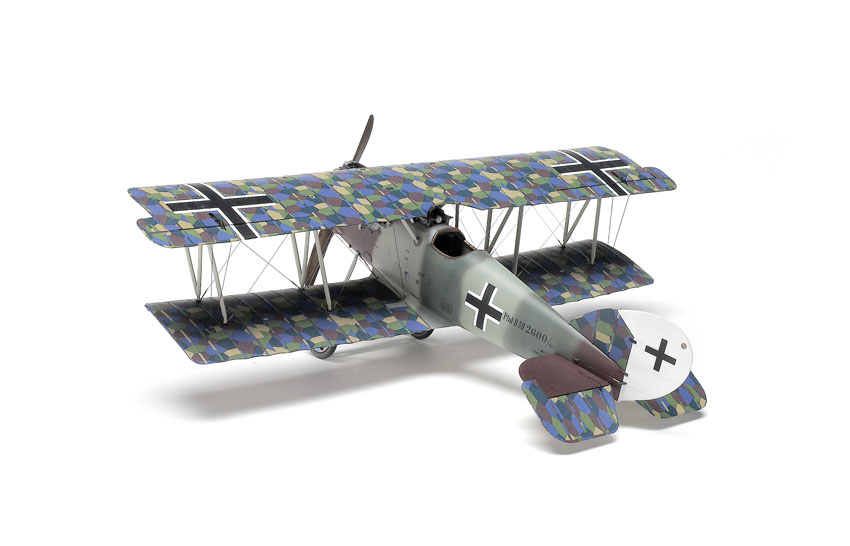
In a reversal of real-life 1918, Wingnut Wings has placed its 1/32 scale Pfalz D.XII in production ahead of the vaunted Fokker D.VII. But while modelers seem to desire the D.VII, Wingnut’s Pfalz does not play second fiddle to any other large-scale World War I plane, regardless of manufacturer. Complete with all the detail and fine fit that Wingnut is famous for, the D.XII adds a new — and welcome — twist by pre-cutting the lozenge decals to fit. That should take some of the trepidation out of the build for many modelers.
While having about the same number of cockpit parts as other kits, assembling the Pfalz cockpit is speeded somewhat by its being painted (instead of wood grain). References can differ, but I painted mine in a light grayish-green. The seat belts can be a bit fiddly to fit, but the attachments can’t be seen once the cockpit is installed. I closed up the fuselage and painted it as a separate assembly. I left off the radiator — an incredible piece of molding — and the nose bowl, and did not install the upper deck and gun assembly until after painting and decaling.
The guns include photoetched-metal jackets, but I think I over-annealed one of mine; I destroyed it during rolling. Luckily, plastic versions are also included, and the etched sight fits well at the front of the plastic jacket. Having chosen the last of five schemes, I left the tail feathers off my bird and finished them separately. The decals were all placed without complaint. But be careful when mounting the elevators — the hinge points are very small.
Fuselage done, I finished all of the various subassemblies that go into a WWI plane. As usual, I fitted my engine later than the instructions say. Wingnut’s standard engine sprue is included, so you once again have spare parts. For the first time, red “over-compressed” markings and numbers are included to spice up the Mercedes.
I undercoated the wings with gloss black in case a hole in the lozenge decals showed through. I needn’t have worried — all the decals fit like a glove, including around all the access-panel cutouts, and were tough enough to withstand dragging around for placement. I used a hair dryer to shrink the decals to the wings instead of setting solutions, as suggested on Wingnut’s website. The instructions would have you glue the struts to the lower wing in a vertical position, then bend them to the correct angle before mounting the upper wing. I couldn’t see how I could get away with that and not stress the upper mounting pins to the breaking point. Instead, I pre-bent both upper and lower mounting pins to the correct angles using a template, then glued the struts in at the proper angle. This worked great, with no stressed pins or a stressed modeler.
I installed all the pre-finished assemblies, including the landing gear, and began the rigging process. I had placed turnbuckles (from Bob’s Buckles) in the pre-molded holes and tied lines onto the top wing before attaching it. I completed all the rigging in short order, and added the control lines to finish all the dreaded — but surprisingly easy — “biplane stuff.”
I completed my Pfalz in an enjoyable, straightforward few hours, which really reflects great kit design and fit. Having decals cut to fit — and they did fit — helped as well. If you haven’t tried a biplane, give Wingnut’s website a look and pick a kit. They are the best of the breed, and can give excellent enjoyment to modelers with a few kits under their belt.
Note: A version of this review appeared in the February 2012 issue of FSM.


