
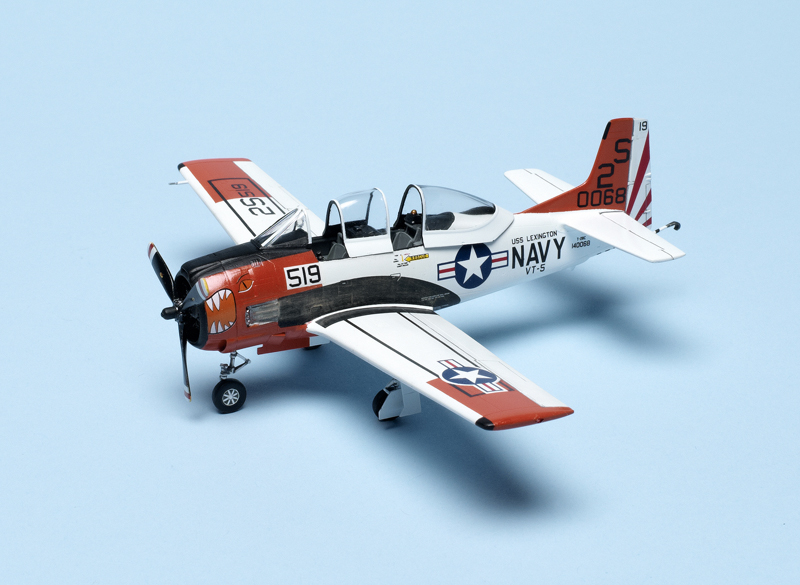
Serving in the U.S. Navy as a replacement for the venerable SNJ trainer, North American’s radial-engined T-28 Trojan was modified with a tailhook and other equipment to train naval aviators in the fine art of carrier operations.
Before Sword’s new family of Trojan kits, modelers with 1/72 scale collections had to backdate Heller’s Fennec, a French counterinsurgency version of the T-28A, to Navy specs.
The plastic parts have excellent exterior detail, good interior and small parts, and the decals are excellent. In this kit, a fine resin casting replaces the plastic engine. Clear parts include a three-part canopy, wingtip navigation lights, and other small items. The two decal sheets contain crisply printed markings for two trainers in white and orange, and one in the more unusual gray and white scheme.
I’ve come to expect trouble melding Sword’s cockpit interior with the fuselage castings, but I was pleasantly surprised by trouble-free fits just about everywhere on this kit.
Instrument panel and console detail are provided with decals, but you could paint the raised/recessed panels. There are no harnesses for the seats.
All the major components play well together, and I used very little filler. But I did encounter a couple of glitches. The instructions show a propeller shaft on the front of the resin-cast engine, but there was no shaft on my sample. But then there was no hole for it in the back of the propeller, anyway, so I just glued the prop onto the engine at final assembly. Also, the nose-gear strut had a T-shaped end instead of the mounting pin as shown, and the nose-gear bay had a mounting hole that was not illustrated. Someone was not on the same page there, so to speak.
A lot of time was devoted to painting the glossy white and orange trainer scheme. The decals, although beautifully printed, are very thin; I feared the orange panels would show through the white star and bars of the insignia. So I masked the shape of the insignias before painting the orange. I used Testor Boyd sunburst for my trainer orange; under fluorescent light it looks better than the proper international orange (FS12197).
Be careful with the decals; they are easily mangled if mishandled.
The finished model is attractive, but there are a few accuracy issues. The U.S. Navy Trojans had a short-profile canopy, but the kit comes with the high-profile canopy of the U.S. Air Force T-28A and the Fennec. It’s not terribly noticeable if the canopy is posed opened. Also, the T-28C had a large-diameter nose wheel with a low-profile tire, but the kit’s wheel is small and the tire is fat. You can cut down the wing-mounted pitot boom by about half. I found the snarling mouth and eye markings for the cowl oversized compared with photos of the real aircraft.
I spent 31 hours on my Trojan. I’m going to build Sword’s B model, too, this time in the early trainer yellow scheme. I hope an aftermarket company comes out with an A model cowl and prop so I can do a natural-metal Air Force trainer, too!
Note: A version of this review appeared in the May 2013 FineScale Modeler.


