
0
0
1
62
355
Kalmbach Publishing Co.
2
1
416
14.0
Normal
0
false
false
false
EN-US
JA
X-NONE
/* Style Definitions */
table.MsoNormalTable
{mso-style-name:”Table Normal”;
mso-tstyle-rowband-size:0;
mso-tstyle-colband-size:0;
mso-style-noshow:yes;
mso-style-priority:99;
mso-style-parent:””;
mso-padding-alt:0in 5.4pt 0in 5.4pt;
mso-para-margin:0in;
mso-para-margin-bottom:.0001pt;
mso-pagination:widow-orphan;
font-size:12.0pt;
font-family:Cambria;
mso-ascii-font-family:Cambria;
mso-ascii-theme-font:minor-latin;
mso-hansi-font-family:Cambria;
mso-hansi-theme-font:minor-latin;}
The lines of the Gamma could still be seen in the A-17, although
dive brakes were installed and the landing gear lost its spats and became
retractable.
In 1937, Douglas dissolved the Northrop Corp. and renamed
the A-17 the Douglas Model 8, soon to become the carrier-based Douglas
Dauntless dive bomber, a hero in the Battle of Midway. The U.S. Army’s
land-based version of the Model 8 was designated A-24 Banshee.

0
0
1
132
756
Kalmbach Publishing Co.
6
1
887
14.0
Normal
0
false
false
false
EN-US
JA
X-NONE
/* Style Definitions */
table.MsoNormalTable
{mso-style-name:”Table Normal”;
mso-tstyle-rowband-size:0;
mso-tstyle-colband-size:0;
mso-style-noshow:yes;
mso-style-priority:99;
mso-style-parent:””;
mso-padding-alt:0in 5.4pt 0in 5.4pt;
mso-para-margin:0in;
mso-para-margin-bottom:.0001pt;
mso-pagination:widow-orphan;
font-size:12.0pt;
font-family:Cambria;
mso-ascii-font-family:Cambria;
mso-ascii-theme-font:minor-latin;
mso-hansi-font-family:Cambria;
mso-hansi-theme-font:minor-latin;}
Epilogue
A bitter Northrop
resigned from Douglas in 1938, vowing to get out of the aircraft business.
However, in 1939, using money from the Douglas buyout, he again founded his own
company, which during World War II built the N-3 Nomad patrol boat for Norway,
subassemblies for Consolidated’s PBY Catalina, worked with Vultee to build the
A-31 Vengeance, and produced more than 700 P-61 Black Widows.
Northrop was able to
resume work on his flying wing, eventually building the massive YB-49 bomber
and selling it to the Truman administration. But the Air Force cancelled his
contract in 1949.
Whether the YB-49’s
demise was due to its poor performance or cutthroat politics — or both — is
still debated today. Northrop died in 1981. But his vision of a highly
efficient, long-range flying wing finally came to fruition in 1989 with the
first flight of the B-2 Spirit stealth bomber.


0
0
1
21
126
Kalmbach Publishing Co.
1
1
146
14.0
Normal
0
false
false
false
EN-US
JA
X-NONE
/* Style Definitions */
table.MsoNormalTable
{mso-style-name:”Table Normal”;
mso-tstyle-rowband-size:0;
mso-tstyle-colband-size:0;
mso-style-noshow:yes;
mso-style-priority:99;
mso-style-parent:””;
mso-padding-alt:0in 5.4pt 0in 5.4pt;
mso-para-margin:0in;
mso-para-margin-bottom:.0001pt;
mso-pagination:widow-orphan;
font-size:12.0pt;
font-family:Cambria;
mso-ascii-font-family:Cambria;
mso-ascii-theme-font:minor-latin;
mso-hansi-font-family:Cambria;
mso-hansi-theme-font:minor-latin;}
Under the Douglas aegis, the Northrop line of aircraft
evolved into the BT-1 and A-17; 110 of the latter were ordered by the U.S. Army
Air Corps.

0
0
1
106
607
Kalmbach Publishing Co.
5
1
712
14.0
Normal
0
false
false
false
EN-US
JA
X-NONE
/* Style Definitions */
table.MsoNormalTable
{mso-style-name:”Table Normal”;
mso-tstyle-rowband-size:0;
mso-tstyle-colband-size:0;
mso-style-noshow:yes;
mso-style-priority:99;
mso-style-parent:””;
mso-padding-alt:0in 5.4pt 0in 5.4pt;
mso-para-margin:0in;
mso-para-margin-bottom:.0001pt;
mso-pagination:widow-orphan;
font-size:12.0pt;
font-family:Cambria;
mso-ascii-font-family:Cambria;
mso-ascii-theme-font:minor-latin;
mso-hansi-font-family:Cambria;
mso-hansi-theme-font:minor-latin;}
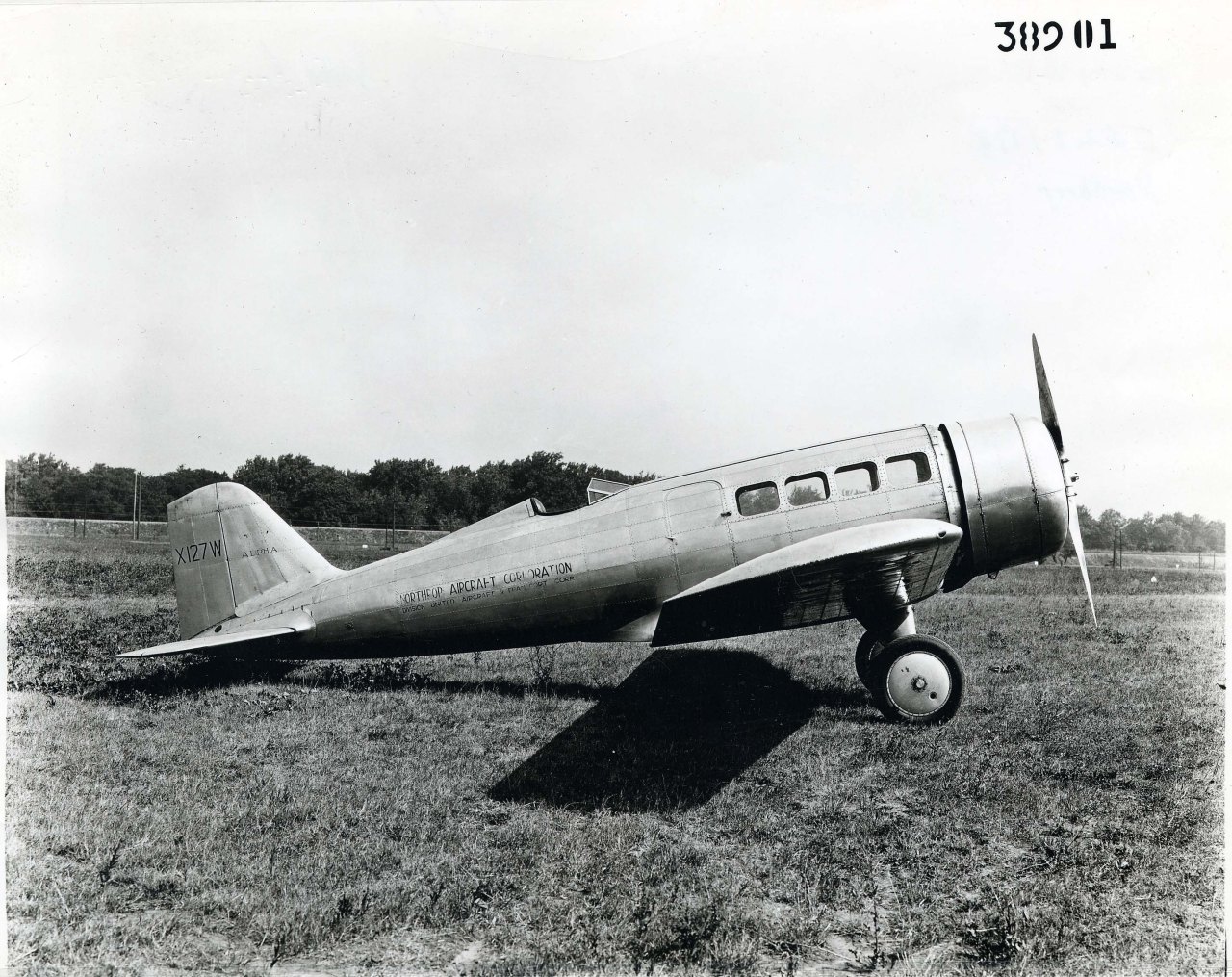
Variants of the Alpha came to include:
• Alpha 2 — a six-passenger transport
• Alpha 3 — two passengers plus cargo; several Alpha 2s were
converted
• Alpha 4 — one-place, open cockpit cargo version with wider
wingspan (2′); converted from Alpha 3s
• Alpha 4A — air-express version
With the rise of bigger airliners, the Alpha was relegated
to cargo and training. But its innovations and aerodynamic features were
carried forward. Northrop resigned from UATC, and, in 1932, formed another new
company, partnering with Donald Douglas. The Northrop wing design and
stressed-skin construction were utilized on the DC-2 and DC-3.
Northrop’s designs proceeded from the Alpha through other
airframes to the Gamma.


To 21st-century viewers, Jack Northrop’s Alpha mail and
passenger plane looks quirky and primitive. However, its 1930 debut marked the
appearance of a seminal design that would lead to permanent progress in
aeronautics and such famous airframes as the DC-2, DC-3, and SBD Dauntless.
Until the late 1920s, Northrop was working with the Lockheed
brothers (neé Loughead). He and Gerrard Vultee had designed the Lockheed
Vega, a popular, speedy, and durable plane of wood construction that was
introduced in 1928.
Northrop, Lockheed’s chief engineer, had even bigger
ideas — including a nascent obsession with the “flying wing” — but Lockheed
was happy with the Vega and more inclined to develop it further.

0
0
1
127
724
Kalmbach Publishing Co.
6
1
850
14.0
Normal
0
false
false
false
EN-US
JA
X-NONE
/* Style Definitions */
table.MsoNormalTable
{mso-style-name:”Table Normal”;
mso-tstyle-rowband-size:0;
mso-tstyle-colband-size:0;
mso-style-noshow:yes;
mso-style-priority:99;
mso-style-parent:””;
mso-padding-alt:0in 5.4pt 0in 5.4pt;
mso-para-margin:0in;
mso-para-margin-bottom:.0001pt;
mso-pagination:widow-orphan;
font-size:12.0pt;
font-family:Cambria;
mso-ascii-font-family:Cambria;
mso-ascii-theme-font:minor-latin;
mso-hansi-font-family:Cambria;
mso-hansi-theme-font:minor-latin;}
So, in 1928, Northrop struck out on his own and founded a
new company — and, at first, struck out. His new Avion Corp. was acquired by
United Aircraft & Transport Corp., a giant holding company that counted Boeing
and Stearman among its possessions. Avion became Northrop Corp., a subsidiary
of UATC.
With the advent of the Depression, Northrop’s experimental
efforts gave way to developing a more-practical, immediately saleable aircraft.
He named the first aircraft of his new enterprise Alpha, and, though it was
less exotic than the airframes of his dreams — fixed landing gear and an open
cockpit would soon be anachronisms — it incorporated several firsts that would
become standard features of modern aircraft, including multicellular wings;
all-metal, stressed-skin construction; and deicer boots at the leading edges of
the wings and tail.

0
0
1
150
860
Kalmbach Publishing Co.
7
2
1008
14.0
Normal
0
false
false
false
EN-US
JA
X-NONE
/* Style Definitions */
table.MsoNormalTable
{mso-style-name:”Table Normal”;
mso-tstyle-rowband-size:0;
mso-tstyle-colband-size:0;
mso-style-noshow:yes;
mso-style-priority:99;
mso-style-parent:””;
mso-padding-alt:0in 5.4pt 0in 5.4pt;
mso-para-margin:0in;
mso-para-margin-bottom:.0001pt;
mso-pagination:widow-orphan;
font-size:12.0pt;
font-family:Cambria;
mso-ascii-font-family:Cambria;
mso-ascii-theme-font:minor-latin;
mso-hansi-font-family:Cambria;
mso-hansi-theme-font:minor-latin;}
“Ever-present in the evolution of civilized man is his
search for improved means of travel …” intoned a marketing brochure for the
Alpha. “… an almost endless procession of models has brought us from the crude
flying machine of yesterday to the fleet, efficient courier of today.”
A cruising speed of 145 mph may not strike us as fleet. But, in the early 1930s, the
Alpha was a swift, dependable, and versatile aircraft.
The U.S. Army Air Corps was willing to test it out. During
trials, Northrop offered two of them as personal transports to Gen. James E.
Fechet, chief of the Air Corps, and Trubee Davison, Assistant Secretary of War
for Aeronautics. The Air Corps ordered three Alphas for VIP transport,
designating one YC-19 and the others Y1C-19. The first was delivered in May
1931.
Business for the Alpha picked up. Transcontinental &
Western Air (the future TWA) flew it as a six-passenger airliner as well as a
mail/expedited delivery plane that could go from New York to Los Angeles in 23
hours.
