
Weathering
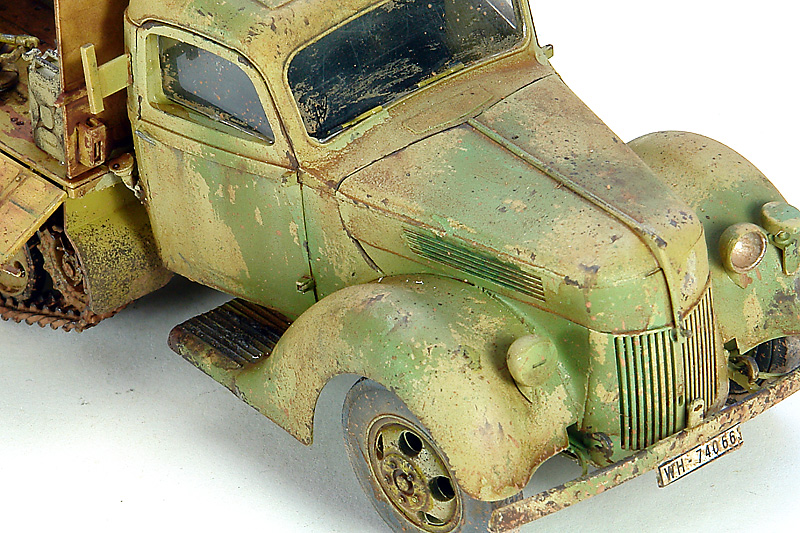
I applied Vallejo chipping medium to all of the components before adding the camouflage colors. I used a lighter shade of Reseda green (RAL 6011) on the truck. The gun received a darker Reseda green and rotbraun for a late-war scheme. Water and a brush scratched and chipped the greens and red brown.
I created rust spots by dipping a sponge in puddles of paint from LifeColor’s Dust and Rust Diorama Set, then dabbing it onto the body. Starting with the darkest shade, I concentrated on the areas of the truck and gun that would be constantly hit or rubbed — fenders, gun-shield edges, steps, bumpers, and wheels. I applied less to the hood, doors, and the body of the gun. I repeated the process through two progressively lighter shades, applying less each time.
Next, I added stains using AK Interactive enamel washes and filters. They dry slowly, so you can correct the work, if necessary, many hours later, even if it seems that it´s already dry. Just add mineral spirit and start again. I painted thin vertical lines of different streaking colors, then blurred them by dragging a flat brush damp with mineral spirits down the surfaces.
I mixed a little graphite powder into Alclad II gunmetal lacquer and hand-painted the cannon with this mix, then gently buffed it with a soft cloth for a metallic sheen.
After a dark chocolate brown artist’s oil wash to enhance panel lines, I applied dots of white, cream, gray, pink, yellow and brown oil paint to flat surfaces. Dabbing and blending the dots with a brush and mineral spirits produced a multicolor filter that subtly altered the base colors.
I used the AK Interactive set for the wheels and tracks. It included a pale grayish brown to age the tires, and a dark brown base to begin rusting the tracks. I continued weathering the tracks using Vallejo washes for rust, then applied a wash mixed with water and rust and graphite pigments. I finished with a layer of earth pigments and water, removing excess with a brush after it dried.


Finishing touches
After assembling the components, I wanted to add an overall layer of dust and dirt. I mixed water and earth-color pigments in a spray bottle — the kind used for misting houseplants — and sprayed the model, then knocked off the excess after it dried.
I applied AK Interactive oil-spill enamels with a fine brush and toothpick. For grease stains, I applied dots of black artist’s oils. A little pigment simulated trapped dirt.
Graphite powder applied to the most exposed spots on the Maultier and FlaK completed the weathering.


Building and painting
ICM’s 1/35 scale Ford V3000S and the follow-up Maultier are delights to build, accurate, and well molded. The kit includes an engine is provided, and fine details such as the pedals and door handles are separate parts.
I built G.W.H.’s FlaK 43 to arm the truck. It went together quickly.
I applied two different shades of dunkelgelb from AK Interactive to the truck and gun. I wanted the finish to reflect the relatively short service life of the gun compared to the truck.


Federico Collada details how he built, painted, and weathered ICM’s Ford V3000 Maultier and G.W.H.’s FlaK 43.
The vehicle
When World War II started, Ford’s V3000 3-ton truck was being built in many countries in Europe, including Germany, France, the Netherland and Belgium. Germany’s armed forces needed to move men and materiel, so Ford vehicles worked alongside Opel and Mercedes trucks on every front.
Operation Barbarossa revealed the limitations of wheeled transports. So many were converted to halftracks using running gear from obsolete tanks and tractors. Designated Maultier, German for mule, these all-terrain vehicles kept moving through the worst weather.
Many trucks and halftrack were converted to antiaircraft platforms to give troops mobile protection from roving Allied fighters. The FlaK 43 was the ultimate version of Germany’s 3.7cm antiaircraft gun, capable of firing 150 rounds per minute.
