
Peacetime and tragedy
After the war, the future looked bright as José and a partner, with capital backing from José’s father, founded an air freight company in southeastern Mexico. They had acquired a new airplane to transport cattle and were looking forward to expanding their business with coffee farmers. “The potential market was huge,” Felipe says.
But on Oct. 31, 1947, José and his partner died when their plane crashed near Cerro Chimborazo, about 20 miles north of Tapachula, Chiapas, Mexico. José was 25.
At the funeral, his father read a eulogy he had written mentioning José’s service with Escuadrón 201. “Honestly, it is difficult to translate because it is describing a father burying his beloved son,” Felipe says.
Uncle Luis, his Kaydet — and fate
Like José, Luis was sent to school in the U.S. — and, like José, he yearned to fly. Felipe says, “My grandfather died of a heart attack in 1952, so he never knew his son Luis was also on his way to becoming a pilot.”
Without a word to his family — “in particular, my grandmother,” Felipe says — Luis got his pilot’s license at age 19, passing his final examination in a Piper J-3C in April 1954. By March 1955 he was certified to fly cropdusters.
Felipe says, “I have learned from my mother that he got involved in cropdusting because the pay was good and he needed the money to support my grandmother, now a widow.”
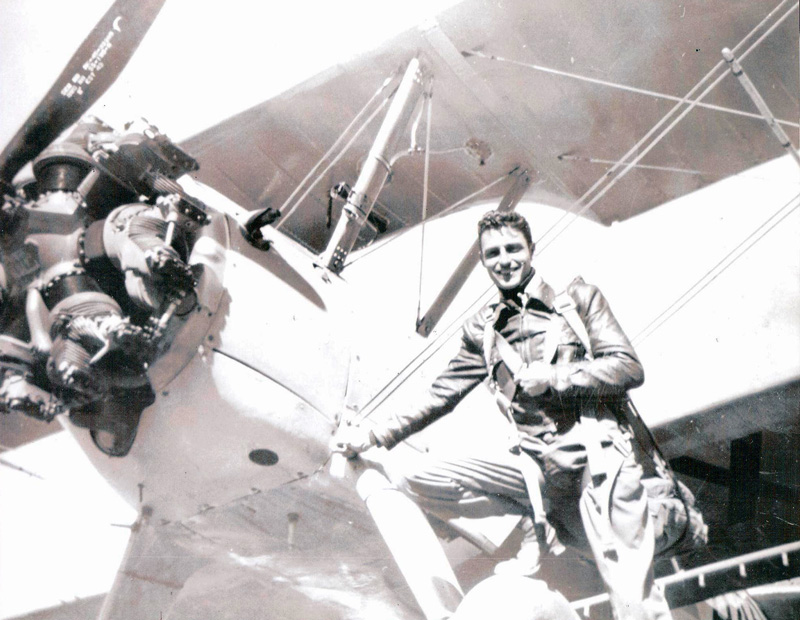
Postwar surplus Kaydets sold for only a few hundred dollars. Their price, low-speed characteristics, and sturdy airframe made them ideal for cropdusting. And that is how the picture of Felipe’s uncle Luis came to be; the spray equipment can be seen on the lower wing of the airplane. The photo was taken in 1957.
Later that year, on June 29, a telegram arrived at Felipe’s home. “My father read the bad news,” Felipe says. “My uncle Luis died in an airplane accident near Hermosillo, Sonora, in northwest Mexico. He was buried there.”
Spraying a field, Luis’ plane had hit power lines and gone out of control. “One of my mother’s brothers-in-law was the only relative at the funeral,” Felipe says.
“As a young boy of 8 at the time, I was unable to understand this second tragedy in my family. My hero was gone and I could not comprehend the immense loss, nor the suffering of my mother, my aunts, and especially my grandmother.
“Through the years I have realized my special interest in aviation and everything related. I believe I would have been a pilot if these tragedies had never happened.
“But I am very happy to remember these two great people, my uncles José and Luis Alvarez.”
This story appeared the April 2017 issue of FSM.
José’s father acquiesced on two conditions: that he would fight on the right side, and that he would graduate with a commission.
José excelled, becoming an officer and flight instructor. After the war he was honored to join Escuadrón 201, known as the Aztec Eagles, Mexicans who flew P-47s with the Allies in the Philippines.
Most modelers take an active interest in history. Sure, a Tiger tank or a B-17 looks cool. But the fascination runs deeper than that. Where others may regard ancient ruins and see only a pile of rocks, modelers likely will linger and gaze across the years to imagine days and stories of long ago.
So, when Felipe García Naranjo Alvarez, an architect, real-estate developer, and modeler from Tijuana, Mexico, asked us to identify an airplane in an old picture of his uncle, we were intrigued. And, sure enough, it came with quite a story.
Name that plane
Felipe’s uncle, Luis Alvarez Vélez, was standing next to a Stearman Kaydet, also known as the Stearman 75 and later built by Boeing. American World War II pilots knew it as the PT-17 (U.S. Navy N2S) trainer. More than 10,000 were built
Carl Yackel, an FSM reader from Bend, Oregon, copiloted B-24 Liberators and remembered the PT-17 well from his training days. “Our flight instructor told us if we ever got in trouble, just let go of it,” Carl said. “He said, ‘This thing knows how to fly better than any of you guys will ever learn.’”
Stationed in Florida, Carl liked to swoop down on the Orange Blossom Special express train, “fresh out of Miami and headed for New York,” he recalls. He had to dive to pick up enough speed to run alongside the locomotive — the Stearman topped out at about 96 mph. The engineer would smile and wave as the train pulled away, Carl recalls, “probably doing about 110.”
Gotta fly
Felipe had two uncles on his mother’s side of the family — and his story actually begins with Luis’ older brother, José Alvarez Vélez, who dreamed of becoming a fighter pilot. Instead, his father sent him to school in the U.S., first at Peacock Military Academy in San Antonio, Texas, then to North Texas Agricultural College in Arlington.
But that was as far as José would go in the field of agriculture. Not yet 21, in 1942 he dropped out of his third year of school and, with $30 in his pocket, hitchhiked to Canada to join the Royal Canadian Air Force, his shortcut to a pair of wings. An accomplice continued to forward his letters home. But when José’s father caught on, he contacted the Mexican consul general in Montreal, who advised José to obtain his father’s consent or return to Mexico.