
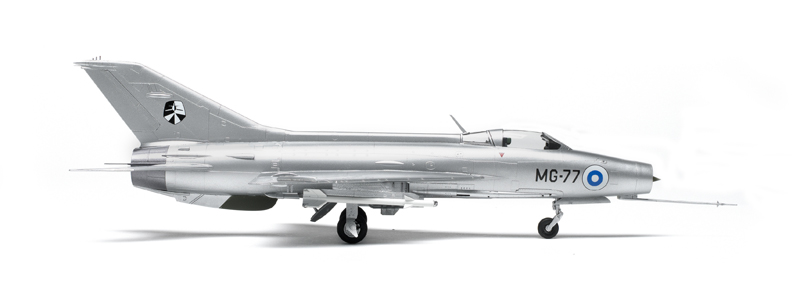
The legendary MiG-21 first appeared in public in 1956, kicking off a career in which it became the most-produced combat jet aircraft in terms of numbers (more than 8,000 built) and duration of production (1959-1985). The F variant was the first production aircraft, with the MiG-21F-13 being the first to be manufactured by the hundreds and widely exported. In China, it was built under license as the J-7. Eventually, it served scores of countries worldwide.
To my knowledge, Trumpeter’s new MiG-21F-13 is the first up-to-date early version of this MiG in 1/48 scale. The kit parts are cleanly molded in light gray plastic. Prominent features include vinyl tires, engine details, and a satisfying selection of bombs, rocket pods, missiles, and drop tanks.
As is customary, I started the model construction with the cockpit. The details there are comprehensive, from the gunsight and instrument panel to the multipiece ejection seat. I will say that the ejection seat doesn’t look correct for this particular MiG version. Some of the side-console detail doesn’t agree with my references, either.
The fuselage has numerous panel insert parts. If you choose to close the speed brake (as I did), check the fit carefully. You may need to do some sanding and filing to get a fit that’s flush with the fuselage.
Before closing up the fuselage, I was sure to add a few lead fishing weights to prevent the plane from being a “tail sitter.”
The plastic of the canopy was flawless and clear, and I was very impressed with its fit to the fuselage.
The wings turned out to be an easy assembly. However, you do need to open slots for the wing fences, wing mounts, and sensors. The wheel-well detail includes oxygen containers, but there are no color callouts for this area of the aircraft. It appears that they should be blue, but check your references.
The wings have separate flaps, but as far as I know these did not drop down when the aircraft was on the ground.
Out of all the available wing ordnance provided by the kit, the most common weapons load would be the K-13/R-3S (NATO reporting name AA-2 “Atoll”) heat-seeking missile; that’s what I chose to install.
I painted my MiG with Tamiya spray-can colors. Markings are provided for six different schemes. The decals applied perfectly with a bit of decal solution to help them adhere.
My primarily reference was MiG-21, by Jiří Bašný, Jiří Brázda, Michal Ovčáčík, and Karel Susa (4+ Publications, ISBN 978-80-900708-0-6). I also found uses for Mikoyan-Gurevitch MiG-21 Fishbed (1955-2010), by Gérard Paloque (Histoire & Collections, ISBN 978-2-35250-147-3).
The finished model looks good against the photos and drawings in my references, and it scales out right on the money. I completed my MiG in 17 hours, less time than usual for me, and I was very pleased with the outcome. Trumpeter’s kit is a straightforward build that I can recommend to modelers at all skill levels. If your interest is in modern Soviet jets, be sure you don’t pass up this kit.
Note: A version of this review appeared in the September 2013 FineScale Modeler.


