
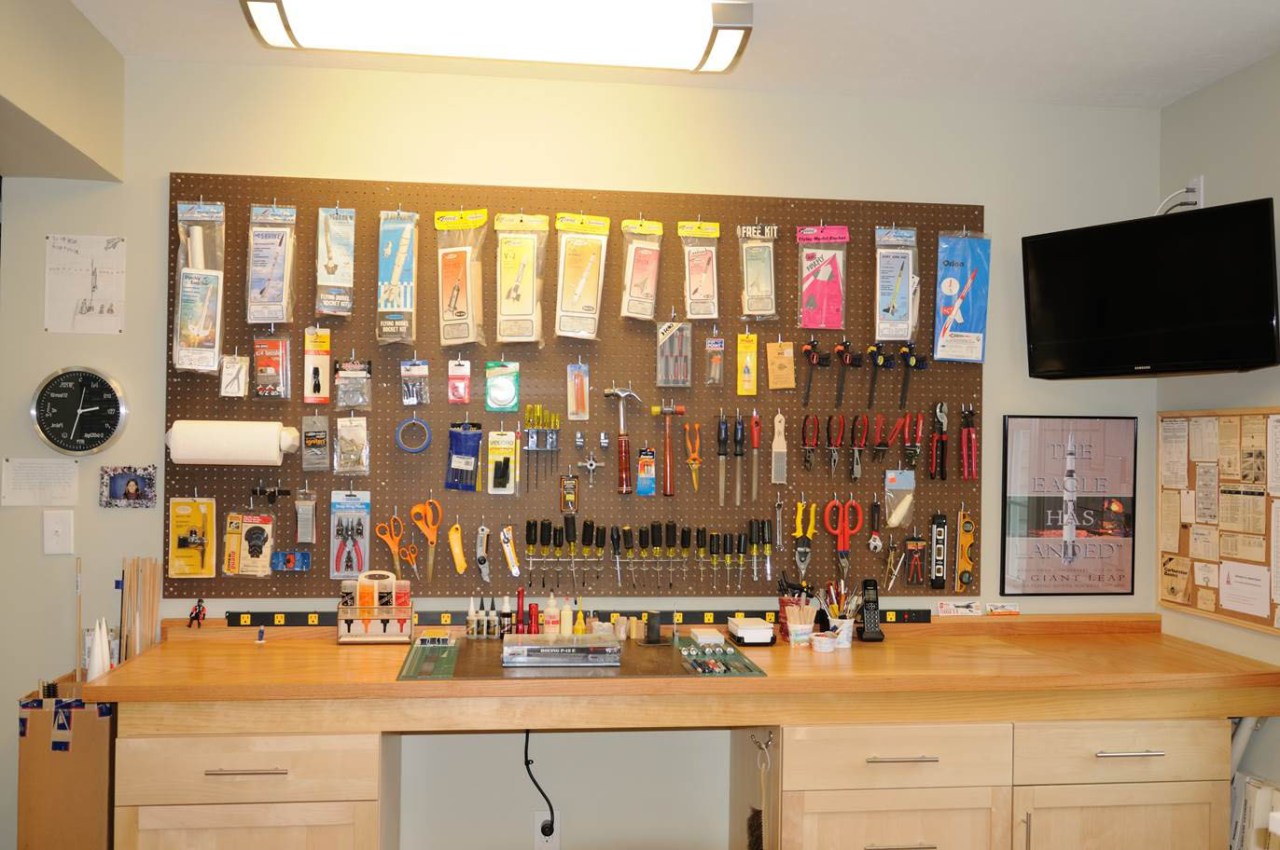
- Use wall space — If you’ve run out of surface space, go vertical and hang a pegboard. There are many different types of holders and hooks you can attach to it to hang all of your tools. Also keep in mind magnetic tool holders, which keep small metal tools up and out of the way while making them visible and easy to grab. If you decide to hang shelves instead, remember that you can spend as much, or as little, money as you want. A simple slab of rectangular wood and brackets will do you fine; sanding and staining are optional.
- Invest in more workable space— If you find yourself building two (or more) models at once, consider expanding your counter space. That way you can move one project to a safe and clear area as you bring the other one to your work station.

- Bring in a bookshelf — Where else will you keep back issues of FSM?
- Keep things close — While the dream may be to have an expansive workbench with tons of counter real estate, the truth is that you want to keep supplies close at hand. When sitting/standing in your main spot, the items you use most often should never be out of reach. Stretch your arms to the left and right, make note of this space, and place storage containers, paints, brushes, and tools here.

If you love your hobby but find it disheartening to model with the chaos surrounding your workspace, then it might be time to organize things.
Just picture sitting down at your cleared off workbench, where every tool has a home and you can find what you need in moments, without digging through clutter. Hold that image in your mind as you start on the organization steps below. Get creative and keep your eye on the prize — a renewed love of your workbench and your hobby.
First, set up an open space on which you can corral items, such as a card table. It will act as a holding area for similar pieces as you’re clearing off or putting together their forever home.

- Re-discover what you have — Before you begin rearranging items, get a good look at the exact amount you really own. Don’t assume you know how many of one type of item you have without compiling them first. Do this by pulling everything from one category out onto your open space. It might seem daunting to corral all of one type of item, such as paint bottles or filing sticks, but this way you can see exactly how much you have and judge how much storage the collection will take up. You might be surprised by how many bottles of olive drab you have…
- Toss what doesn’t work — We’ve all bought those items that promise to be life-changing, but don’t live up to that promise. Do you find yourself avoiding certain tools in favor of a similar but different one? Toss of these space-clogging things! The most organized space in the world won’t mean much if it’s filled with pieces you don’t enjoy using. Get rid of the broken, clunky, dried-up, rusty, leaky, and generally unliked. You’ll spend more time at your workbench if you like the items you’re surrounded by.
- Designate a spot for everything — There most definitely is a place for all the items in your workshop. Some are obvious: paints on a rack, pencils in a cup. Other objects don’t have a well-defined storage area, but it’s easy to make one using solutions from around your home. Put round bottles on a lazy Susan; collect sandpaper in shoeboxes; loose miscellanies corralled in cups and bowls. As much as possible, store similar things together.
